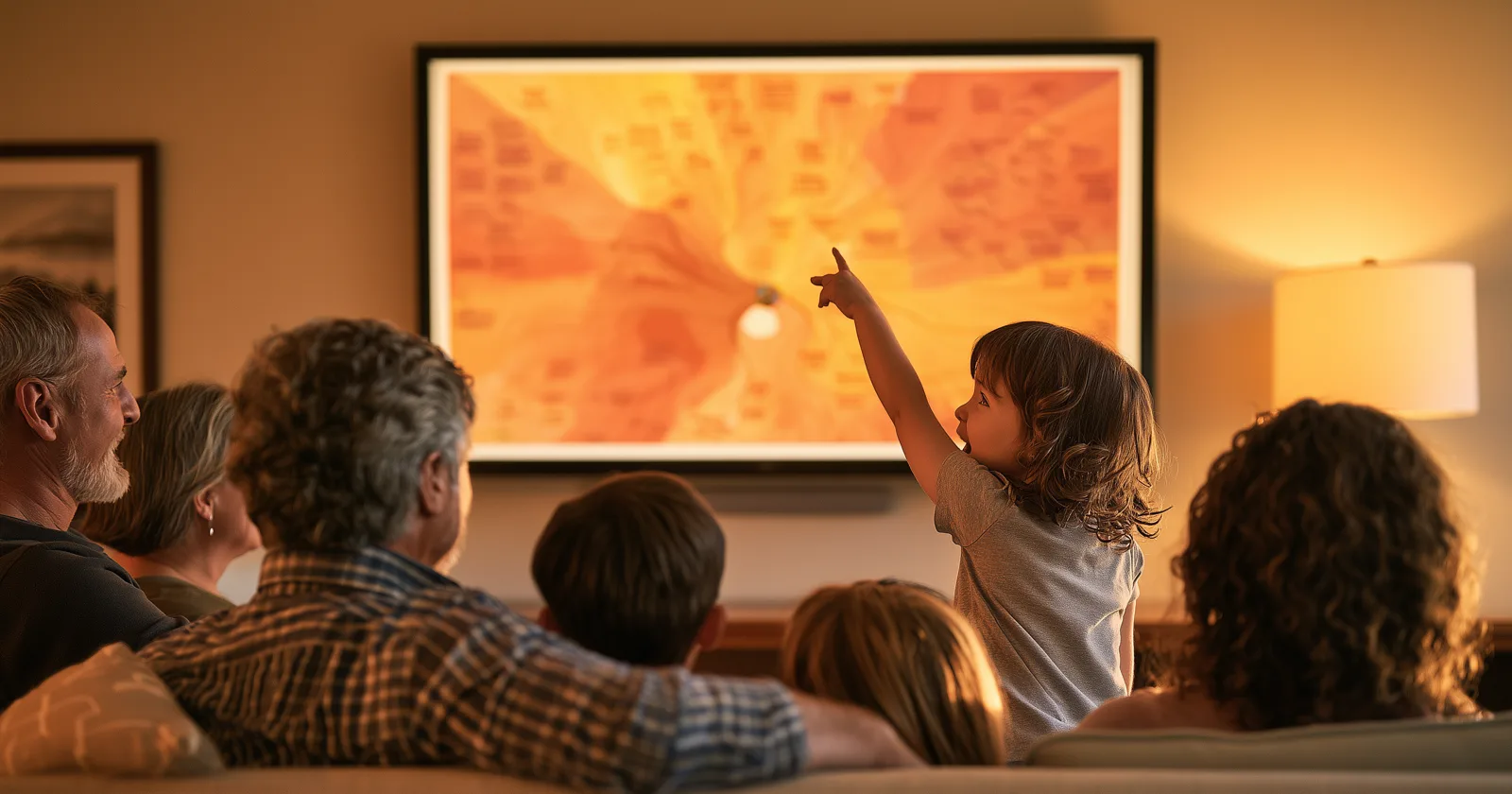
Here's how most family history nights go.
Someone who has done the research — usually the one person in the family who has done all of it — brings out a binder. There's a printed chart, and it's genuinely impressive, and everyone says so. Then that person starts explaining, because there's a lot to explain and they've been waiting years for someone to ask. Around minute nine, the eleven-year-old asks if they can go.
The research wasn't the problem. The format was. Here's one that works.
Three rules before anything else
Forty-five minutes, hard stop. End while people still want more. Every failed family history night in history ran long.
Nobody presents. The moment one person is standing and everyone else is sitting, it's a lecture and it's over. Whatever you do should be something the group does together.
One screen everyone can see. Not a laptop that gets passed around, not a binder people lean over. Something on the wall that everyone in the room is looking at simultaneously. This single change does more than anything else on this list, because shared attention is what makes a room feel like a room.
Five formats that actually work
Pick one. Not three.
1. "Who's the oldest person here?"
Start with the room, not the past. Go around: who's the oldest person present, who's the youngest, and how many years between them.
Then push it back one step at a time. Who's the oldest person anyone here met? Almost every family has someone who, as a small child, met a great-grandparent born in the 1890s. That's two handshakes to the nineteenth century.
Then: who's the oldest person anyone here has a photograph of. Then a name for.
By the end of ten minutes you've walked the room from the present to the edge of documented memory, and everybody participated. This is the best opener there is, and it costs nothing.
2. The map
Pull up a map — paper, phone, or on the screen — and place your ancestors on it.
For most families this produces at least one genuine surprise: a country nobody knew about, a migration that went sideways rather than in a straight line, a great-grandmother who moved four times before she was twenty.
Kids in particular respond to this one, because it converts abstract names into places that exist and can be pointed at. Follow it with the obvious question: why did they leave? You often won't know. Speculating together is more than half the fun.
3. Guess the photo
Pick five old photographs. For each, before saying anything: who do people think this is, and what year?
Take guesses from the youngest people first, so they're not just agreeing with an adult. Then reveal.
The reason this works is that it makes everyone an active participant in a photograph rather than a viewer of one. And the wrong guesses are frequently better than the right answers — "that looks like Uncle Dave" from a nine-year-old about a man born in 1901 is exactly the kind of thing that lands, because it's true, and now the nine-year-old is in the family resemblance rather than outside it.
4. Record a grandparent
If someone from the older generation is in the room, spend twenty minutes recording them. A phone on a table is sufficient. Don't over-produce it.
The trick is the questions. "Tell us about your childhood" gets you nothing. Specific questions get you everything:
- What did your kitchen smell like?
- What did your mother worry about?
- What was the first thing you bought with your own money?
- What did you do on a Saturday when you were fifteen?
- Who in the family was everyone slightly afraid of?
- What's something you were told about your grandparents that you've never been sure was true?
That last one is the best question in genealogy. It produces family legends, which are half the reason anyone starts researching.
Let the kids ask some. They ask things adults are too polite to.
5. The name game
Go through the names on the chart and find out what they mean and where they come from. Occupational surnames, place surnames, patronymics — most people have never thought about the fact that their last name was once a job description or a village.
Then the first names: who was named after whom. Nearly every family has a name that repeats across four generations, and tracing it is a five-minute activity that permanently changes how a child feels about their own middle name.
What to put on the screen
The point of the screen is that it holds the room's attention in one place while people talk. It's the campfire.
A slideshow works. A tree on the wall works better, because it doesn't advance on its own — it stays wherever the conversation is. Someone mentions a great-grandmother, and the chart moves to her, and then it stays there while five minutes of conversation happen about her. Then someone asks who her father was, and you go there.
That's the actual mechanic of a good family history night: the screen follows the conversation instead of driving it. Slideshows can't do that, because a slideshow has a running order and a conversation doesn't. More on getting a tree onto the TV.
Ages
Under 7: photos and faces only. Skip dates entirely. "This is your grandma's grandma" is the whole concept and it's enough.
8–12: the map and guess-the-photo. This age is genuinely good at family history — old enough to grasp time, young enough to find it magical rather than morbid.
Teenagers: ask them to run the recording. Give them a job with authority in it and they'll engage; give them a chart to look at and they won't. This is universally true and worth exploiting.
Adults who aren't into genealogy: lead with the stories, never the sources. Nobody outside the hobby cares that a date is confirmed by a census record. They care that she crossed an ocean at nineteen and never saw her mother again.
What not to do
Don't correct people mid-story. If an uncle says the family came from Cork and you know it was Kerry, let it go until later. The story matters more than the county tonight, and correcting someone in front of the family is how you get one participant instead of eight.
Don't try to cover the whole tree. You will not get through six generations in forty-five minutes and you shouldn't try. One branch, done properly, beats all of them skimmed.
Don't skip dinner. Do this after food, not instead of it.
Don't make it annual. Anything that happens once a year becomes an event with expectations. Do it on an ordinary Tuesday, badly, and do it again in a couple of months.
The point
The research is the hard part and it's already done. What's usually missing is a night where the family is in one room, looking at the same thing, and someone's grandmother gets talked about out loud.
That's not a genealogy problem. It's a logistics problem — and forty-five minutes, one screen, and a couple of good questions solves it.
Keep reading: