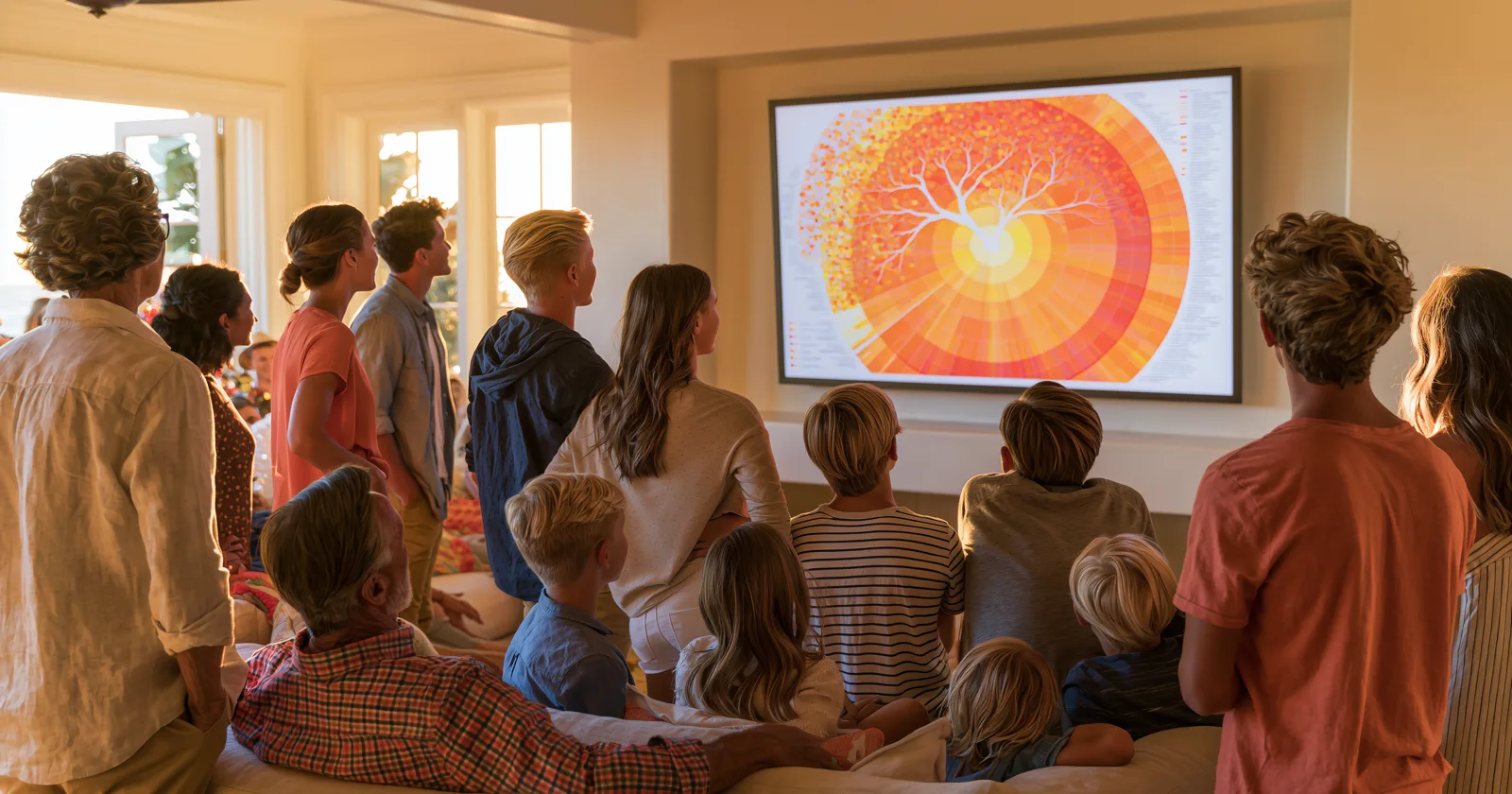
Every family reunion has the same unsolved problem: half the room can't name the other half. Cousins wave at cousins they can't place; the kids don't know which great-aunt is which; somebody's new spouse spends the afternoon nodding.
The family tree solves exactly this — and a reunion is the one day a year the whole tree is standing in the same room as its diagram. Here's how to make it the centerpiece instead of a printout on the snack table.
Before: the setup checklist
Get the tree connected ahead of time. Whatever the source — FamilySearch (free to start), a GEDCOM file, an Ancestry tree — have it loaded and tested the week before, not the morning of.
Claim a TV. The host's living room is ideal. If the reunion is at a hall, most venues have a screen with HDMI; a streaming device like an Apple TV or Fire TV stick travels in a pocket, and a laptop running the web viewer over HDMI is a fine fallback.
Do a ten-minute rehearsal. Find the common ancestor everyone descends from and practice re-centering on them, then gliding down to a few of the branches in the room. You're the pilot for the first five minutes; after that the remote won't come back to you.
During: three activities that actually work
The orientation tour (first 15 minutes). Once most people have arrived, center the tree on the common ancestor and walk down to today — "this branch is the Ohio cousins, this one's everybody from Marie's side." Five minutes of this saves fifty introductions, and the new spouses will quietly thank you.
The elders' turn. Hand the remote to the oldest generation and let them drive. They'll head straight for their own parents and grandparents, and the stories will start without prompting. Put a phone on the table recording audio (ask first) — a reunion is the only day you'll get three siblings correcting each other's memories in real time, and that argument is the source material.
The kids' scavenger hunt. Give the under-twelves a list: find yourself; find the oldest person on the whole tree; find the ancestor with the most children; find someone born in another country. First to finish picks the dessert. It sounds silly and it works every time — a child who has raced through six generations knows the family in a way no lecture produces.
After: capture before they scatter
Reunions concentrate knowledge for one afternoon and then disperse it for a year. Before people leave: note every correction and story lead the elders offered (the tree gets updated later, back at the research source), take the group photo in front of the tree on the screen — the diagram and its people in one frame — and share view access with any relatives who ask, so the tree keeps working after the folding chairs are stacked.
Why this beats the banner
The paper chart taped to the wall is a fine reunion tradition — keep it, let people sign it. But paper answers no questions. A tree on the big screen re-centers on whoever someone is curious about, opens a census page when an elder starts a story, and lets a nine-year-old find herself two rings from an ancestor born in 1870. One is a decoration. The other is the afternoon people talk about on the drive home.
Related reading: How to Show Your Grandparents the Family Tree · 12 Family Tree Display Ideas That Aren't a Poster