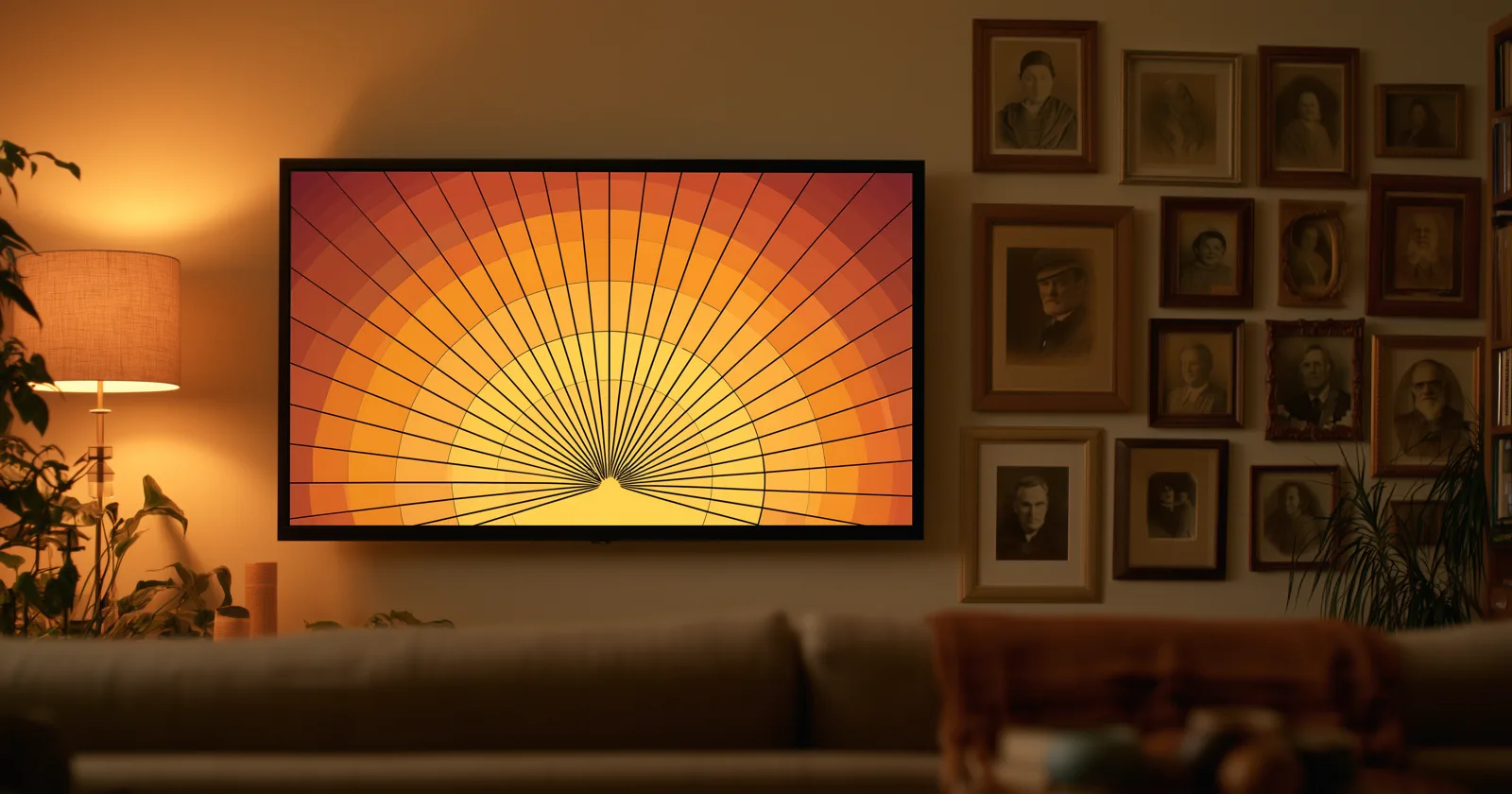
Search "family tree display" and you'll drown in the same idea: a poster. A vinyl wall decal of a tree with photo frames glued to the branches. Fine — but your family's story deserves more range than one craft-store aesthetic. Twelve better directions:
1. The living-room TV. The biggest, best screen in the house, already positioned where the family gathers. A TV-native app like Bright Branches makes the tree itself the display — full-color, six generations, explorable from the couch with the remote, and switchable between designs (a fan chart one day, an organic tree the next). The only option on this list that's alive.
2. A large-format fan chart print. Generate a print-ready file and take it to a local print shop for a 24×36 or larger. Framed, a filled fan chart reads as art first and genealogy second — which is exactly why guests ask about it.
3. The screensaver. Display ideas usually assume effort. This one is the absence of it: leave the tree running and let it become slow-moving ambient art whenever the TV is idle. The family history stays present in the room without anyone doing anything.
4. A gallery wall with a chart as the anchor. Ancestor portraits scattered up a staircase are lovely but disorienting — who's who? Anchor the arrangement with a small printed chart in the center, and the portraits suddenly have a map.
5. One frame per branch. Instead of one giant everything-chart, print four small charts — one per grandparent's line — and hang them as a set. Modular, and each side of the family gets its own moment.
6. The migration map pairing. Frame a map beside the tree with the family's journey marked — the village to the port to the farm to the city. Trees answer "who"; the map answers "how far." Together they're a story.
7. A coffee-table book. Photo-book services make this easy: chart in the front, then a spread per generation with photos and one good story each. The format strangers actually pick up and read.
8. The reunion banner. For gatherings: a wide-format print of the descendant chart from the common ancestor down, taped to the wall where everyone signs their own name. Cheap, participatory, and it gets better every reunion.
9. A quilt or embroidery. The slowest option and the most permanent. Names stitched per generation, in rings or rows. Heirloom in the literal sense — the display becomes an artifact future genealogists will cite.
10. The kids'-room pedigree. A small five-generation chart at child height with the child at the center. Kids who grow up seeing themselves at the middle of something big ask questions decades earlier than the rest of us did.
11. A memorial display. For a funeral or remembrance: the tree centered on the person being honored — their ancestors behind them, their descendants spreading in front. It reframes a life as a link in a chain, which is often exactly the comfort a room needs.
12. The digital photo frame, upgraded. Load a rotation of chart images and ancestor photos into a quality digital frame for the hallway or office. Not as capable as the TV, but always on, and better than the frame's default vacation slideshow.
The pattern worth noticing
Half of these are static and half are alive, and the split matters. Prints, quilts, and books honor the tree; screens let people ask it questions. The strongest homes for family history use one of each — something permanent on the wall, and something explorable on the TV for the moments when "who's that?" deserves a real answer.
Related reading: How to Display Your Family Tree on a TV · How to Show Your Grandparents the Family Tree