Genealogy has a subscription problem. Records cost money, DNA costs money, hints cost money, and after a while it starts to feel like looking at your own family costs money too.
It doesn't. Here's every genuinely free route — with the catches stated plainly, because "free" in this industry usually has a footnote attached.
Free, and actually free
FamilySearch
The largest free option by a distance. A nonprofit family history service, no subscription and no tiers, holding billions of indexed historical records and a single shared tree that everyone contributes to.
You make an account, enter what you know, and frequently find that someone has already documented generations behind your grandparents. You can view your tree, search records, attach sources, and print charts, all at no cost.
The catch: the tree is shared rather than private, so other people can change profiles you contributed to. It's a real trade-off with real upsides. No catch on cost — there isn't a paid tier waiting. More on how it works.
Gramps
Free and open-source desktop software for Windows, Mac, and Linux. Reads and writes GEDCOM, produces charts and reports, and handles large trees without complaint. Genuinely the most capable thing on this list.
The catch: the interface was built by people who use it daily, and it shows. Budget an afternoon.
Free tiers of commercial desktop software
RootsMagic Essentials is a free tier of a well-established program and considerably friendlier than Gramps. Legacy Family Tree has a free edition too. Both will open a GEDCOM, show you charts, and let you explore.
The catch: features are held back for the paid versions. For viewing and basic charts, the free tiers are fine.
webtrees
Free, open source, and excellent — a private family website with a proper tree viewer, which you can share with relatives.
The catch: you host it. Web server, PHP, database. A weekend project if you're comfortable with that, a non-starter if you aren't.
A text editor
Zero setup. A GEDCOM is plain text, so Notepad or TextEdit will open it and show you what's actually in the file. No chart, but it answers "is there anything in here" in thirty seconds. More on what's inside.
Free with a caution attached
Drag-and-drop GEDCOM viewers — several sites let you upload a file and view it instantly with no account.
Convenient, and fine for a tree of long-deceased ancestors. Think harder if the file contains living relatives: you're uploading names, birth dates, and addresses for people who didn't agree to it, to a service whose retention policy you haven't read. The convenience is real; so is the trade.
Free trials are not free. Obvious, but worth saying — several major platforms lead with a trial that requires a card and converts silently.
Free ways to get it off the screen
Two things that cost nothing and matter more than any of the above.
Print a chart. Every program listed here exports charts. Take the file to a copy shop, or print it tiled at home and tape it together. A framed six-generation fan chart is the single best genealogy object there is, and the file to make one costs nothing. How to do it properly.
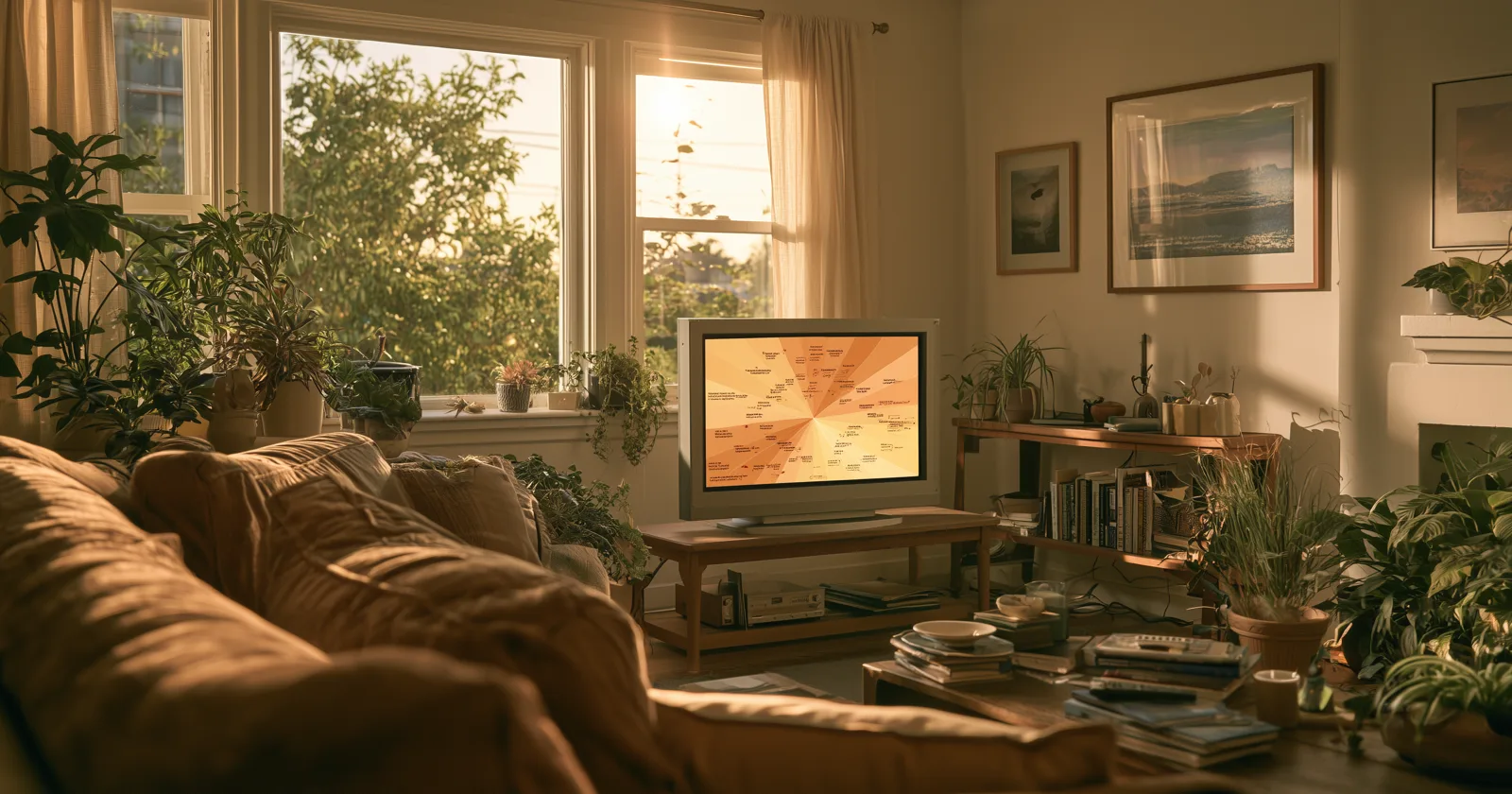
Point your TV's photo screensaver at scanned family pictures. Apple TV, Google TV, and Fire TV all do this already, free, using an album you already have. It isn't a family tree, but it puts your family on the wall this weekend with no purchase of any kind. More on ambient displays.
What we do for free, and where we don't
Bright Branches is a paid product, so treat this section with appropriate scepticism. Here's the honest shape of it.
Free for FamilySearch members. If your tree is on FamilySearch, you can sign in and put it on your television at no cost — the fan-chart design, preset palettes, and screensaver mode, on Apple TV, Google TV, Android TV, Fire TV, iPad, and the web viewer.
The reason is simple enough to state: FamilySearch is free, so seeing your FamilySearch tree on your own TV should be too. Charging for the last ten feet of something a nonprofit gave away didn't sit right.
Printing is free on every plan, including the free tier. No watermark, no per-chart charge, no limit. There's no checkout and no shipping — the file is yours, print it wherever you like, as many times as you want.
What costs money: the other four designs, custom colors, animated backgrounds, and the expanded photo-backdrop library — the free tier includes five of your own photos. And GEDCOM and Ancestry trees need paid hosting, because unlike a FamilySearch tree — which stays where it is and is fetched live — an uploaded tree has to be stored and served by us. Details on the pricing page.
That's the whole boundary. If you're a FamilySearch user who wants the fan chart on the wall, you never have to pay us anything, and the free tier isn't crippled to force an upgrade.
The one-line version
If all you want is to see your family tree, the answer is FamilySearch plus a printed chart, and it costs nothing.
Everything else — including everything we sell — is about how it looks, where it lives, and who else in the family ends up seeing it. Those are real things worth paying for if you want them. But nobody should be under the impression that access to their own ancestors is behind a paywall. It isn't, and it hasn't been for years.
Keep reading: