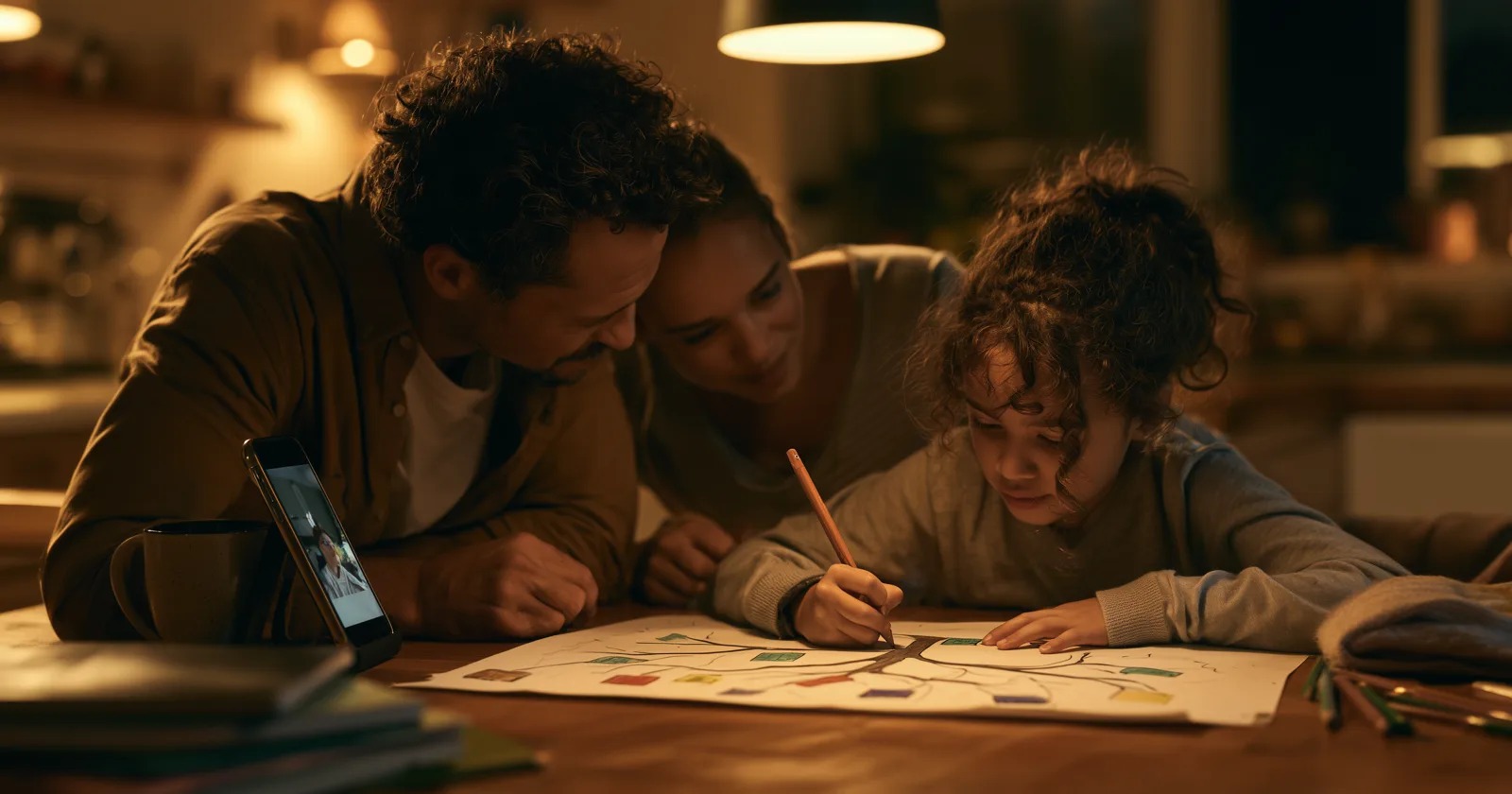
The assignment comes home in a folder. It's a photocopied sheet with boxes on it — usually four generations' worth — and it's due Friday.
Most families fill it in from memory in twenty minutes, hand it in, and forget about it. That's fine, and if that's what tonight requires, skip to the next section and you'll be done.
But this assignment is one of the very few that can turn into something a kid keeps. Here's how to do that without turning a Tuesday evening into a research project.
How far back to actually go
Three generations is plenty. The child, their parents, their grandparents. If great-grandparents come easily, add them; if they don't, stop.
Teachers ask for four because four fits on a page, not because four is the target. A completed three-generation chart with a story attached to every person beats a four-generation chart with half the boxes guessed at, and any teacher will tell you the same.
There's also a practical reason to stop early. Generation four is eight people, and for most families that's where memory ends and research begins. Research is a different activity with a different timeline, and it does not fit before Friday.
Where the information actually comes from
Here is the entire answer: call a grandparent.
Not a website. Not a records search. A phone call, on speaker, with the kid in the room and the worksheet on the table.
This is worth understanding, because it's the actual point of the assignment. The teacher is not testing whether your family can use a genealogy database. The assignment exists to make a child talk to an older relative about something the older relative knows and the child doesn't. That's the whole curriculum objective, and it's a good one.
So put the phone on speaker and let the kid ask. They'll do it badly at first, then get interested. Twenty minutes on the phone will fill the worksheet and produce two or three things nobody expected — a middle name that came from somewhere, a town nobody had mentioned, the fact that a great-grandfather was one of nine.
If there's no grandparent to call, the next best sources are an older aunt or uncle, a cousin who has already done some of this, or a parent's own memory prompted by photographs. Photographs are unusually good prompts. Put a picture in front of someone and they remember things they can't produce cold.
When the worksheet doesn't fit your family
The standard template assumes two parents, four grandparents, one household, and one surname running down the middle. A lot of families are not shaped like that.
Adoption. Step-parents and step-grandparents. Blended households where a child has six people who function as grandparents. Foster care. A single parent. Donor conception. A parent who isn't in the picture, or isn't known, or died. Same-sex parents facing a form with "mother" and "father" printed on it.
If that's your family, here's the practical position, and it's worth saying to your child directly rather than working around it:
The tree is the family that raised you. Put the people who are actually your family in the boxes. A step-grandmother who has been there since you were two goes in the box marked grandmother. If a box doesn't apply, cross out the label and write the right one. If there are more people than boxes, add boxes on the back — a child who hands in a chart with too many people on it has not made an error.
Biology is a separate question, and it can be a separate chart. If your child is adopted and curious about birth family, that's a real and legitimate interest, and it is not the same document as this one. It also isn't a Tuesday-night activity. Keep the two apart.
Tell the teacher if it's going to be difficult. A short email — "our family doesn't fit the template, he'll be handing in something a bit different" — takes two minutes and heads off a version of this where a child feels singled out in front of a class. Teachers deal with this constantly and are almost always glad to be told.
The thing to avoid is a child quietly deciding that their family is the wrong shape for the form. That's a real risk with this assignment, it's entirely preventable, and preventing it is worth more than the grade.
Making it good instead of merely done
Four things that take almost no extra time and change what the finished object is.
Put dates and places on it, not just names. "Grandpa Bill" is a name. "William Reilly, born 1948, Dearborn" is a person located in time and space. It's the difference between a worksheet and a record.
Add one fact per person. What they did for work, where they were born, one thing they were known for. This is the part kids actually enjoy, and it's what makes the chart worth keeping. "Great-grandma Ruth — worked at the switchboard, made terrible pie" is a better entry than any date.
Include a photo if you can. Even one, of the oldest person on the chart. A face changes how everyone reads the page.
Write down the stories that don't fit. During the phone call, someone will say something that has no box on the worksheet — how the family got here, why a name repeats, what a great-grandparent was like. Have your kid write those on the back. That's the part that gets read again in ten years, and the boxes aren't.
What to do about the parts nobody knows
You will hit a blank. Everybody does.
Write "unknown" and move on. It's an honest answer and it's a real one — professional genealogists write it constantly. A blank box is not a failure; it's the current state of what the family knows.
If your child wants to know why nobody knows, that's a genuinely good question with real answers: records were lost, families didn't talk about certain things, people emigrated and left everything behind, someone died young and their children were too small to remember. Any of those is a more interesting conversation than the worksheet.
Don't guess and write it down as fact. If you're unsure whether it was 1923 or 1926, write "about 1925." Approximation is standard practice; invention isn't.
If it turns into more than an assignment
Sometimes it does. The kid gets interested, the grandparent gets interested, and suddenly there's an appetite for more than four boxes.
If that happens, FamilySearch is the place to go next and it's free — no subscription, no trial. Enter what's on the worksheet and there's a fair chance you'll find someone has already documented generations behind it.
Be ready for the shape of what comes next, though. Six generations is 126 people, which sounds fun until you see it on a page. The arithmetic gets strange quickly, and the resulting chart is a genuinely satisfying thing to grow into over years — but it is not a school assignment anymore, and it shouldn't be treated as one.
The worksheet is due Friday. The rest of it, if it happens, has no deadline at all.
Keep reading: