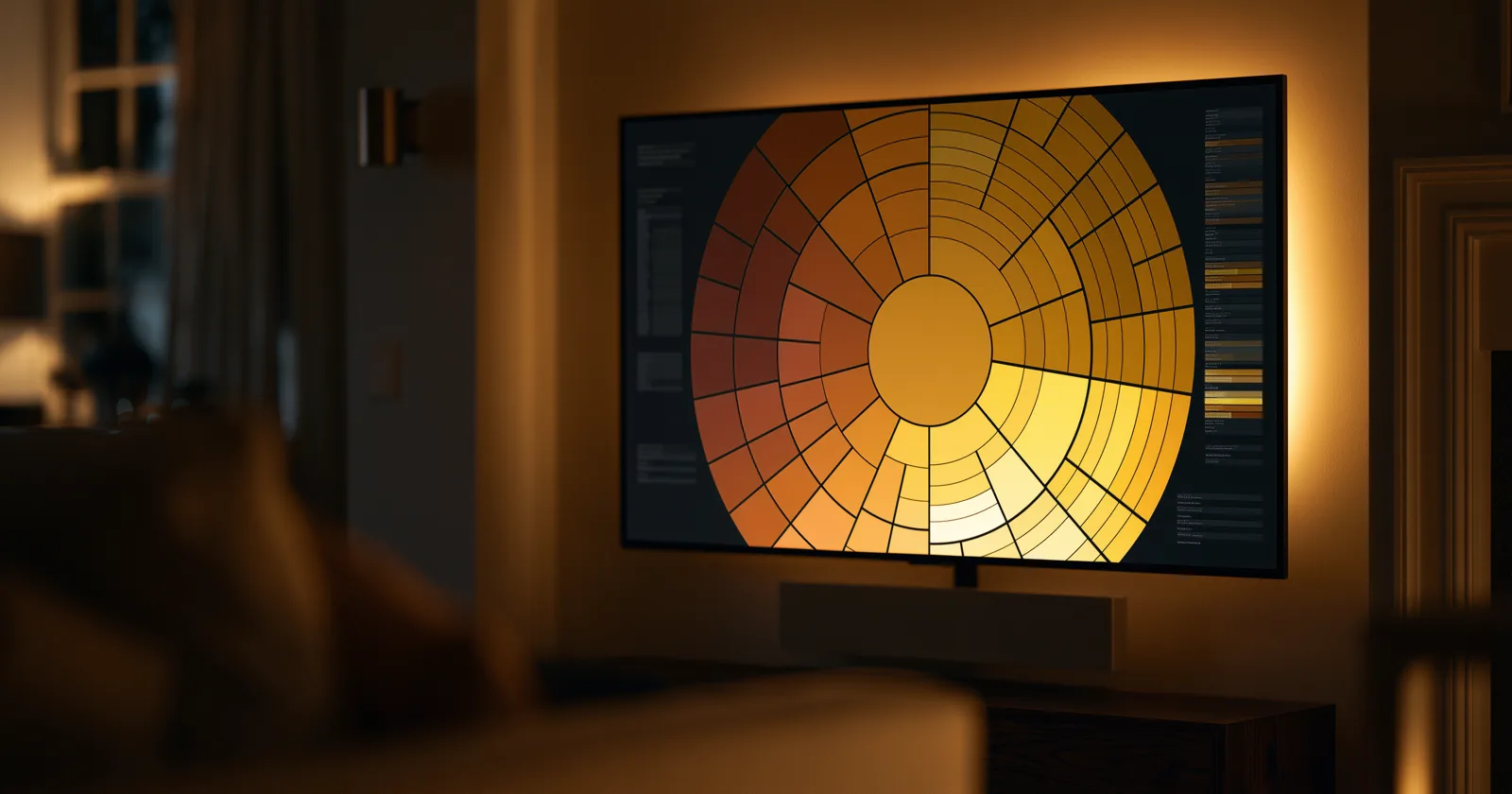
Every field has one diagram that outgrows its job and becomes an emblem. Chemistry has the periodic table. Astronomy has the H-R diagram. Genealogy has the fan chart.
How to read one
A fan chart puts one person at the center — the focal person — and arranges their ancestors in concentric arcs radiating outward. The first ring splits in two: father on one side, mother on the other. The next ring splits into four grandparents, then eight great-grandparents, and so on, each ring doubling until the rim.
That's the whole grammar. Move outward, go back in time; any wedge's two "parents" sit directly behind it in the next ring. Once you've read one fan chart, you've read them all.
Why it beats boxes and lines
The traditional pedigree chart — boxes connected by lines, marching left to right — does the same job on paper. The fan wins for three reasons:
Density. Doubling generations fit naturally into widening arcs. Six generations — 126 ancestors — sit comfortably in one circle that a boxes-and-lines chart would need a hallway to display.
Honesty. Empty wedges are instantly visible. A fan chart doesn't just show what you know; it shows exactly where the research stops, which is why serious genealogists use fans as progress maps. A blank quarter-arc is a to-do list you can feel.
Beauty. This is the unserious reason and the most important one. A filled fan chart is symmetrical, dense, and quietly monumental — the rare genealogy artifact non-genealogists stop to look at. It's the format people frame.
The fan chart's second life
For a century the fan chart was a paper object — hand-lettered, then printed, then generated as a PDF. FamilySearch's on-screen fan view brought it to the browser, where clicking a wedge re-centers the chart on that ancestor: suddenly the fan wasn't a picture of one person's ancestry but a lens any family member could look through.
The newest chapter moves it to the television. Bright Branches' signature design, GeoMeTree, is a fan chart built for the big screen: the wheel of ancestors fills the display, and anyone with the remote can glide across the arcs and land on any name — the chart smoothly reorients so that person takes the center, their own six generations fanning out around them. The same diagram genealogists have loved for a century, finally at a size the whole family can gather around.
Getting your own
If your tree lives on FamilySearch, you already have a fan chart waiting — both in FamilySearch's own fan view and, on the TV, the moment you sign into Bright Branches (free to start). GEDCOM and Ancestry trees work too. And when the chart is filled and glowing, print it: a six-generation fan on the wall is the rare piece of decor with 126 stories in it.
Related reading: What Is an Interactive Family Tree? · 12 Family Tree Display Ideas That Aren't a Poster