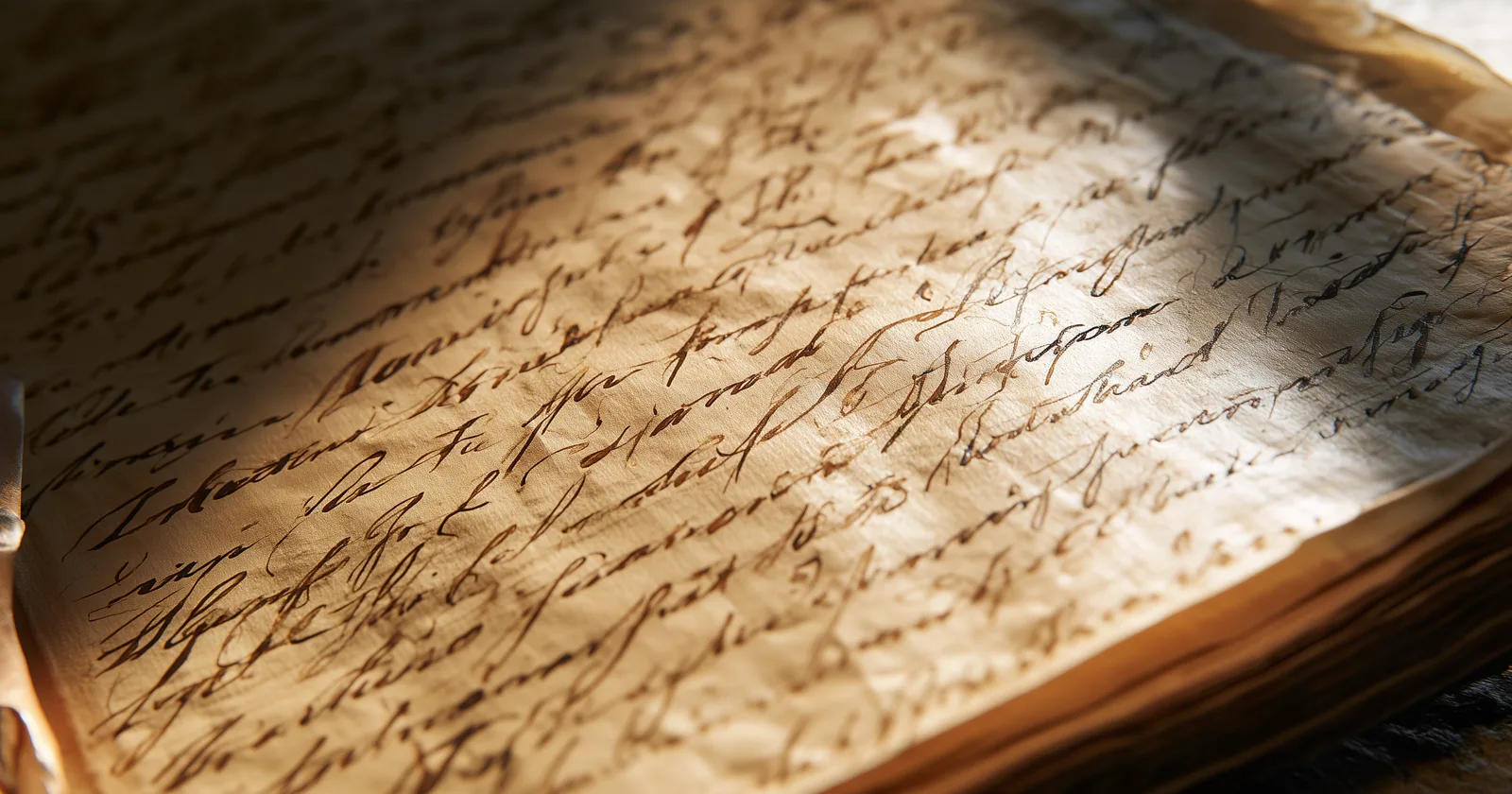
You've found the right parish register. The right year, the right page, and there — third entry down — is a name that could be your ancestor.
You cannot read a word of it.
This is a skill, not a talent, and it's more learnable than it looks. Most of what makes old documents impenetrable is a short list of specific conventions that nobody uses anymore. Learn the list and a page that looked like a scribble resolves into ordinary writing by a person in a hurry.
The letters that aren't what they look like
The long s. The single biggest source of confusion in English documents before about 1800. A lowercase s at the start or middle of a word was written as a tall character that looks almost exactly like an f — the difference is that it has a nub on the left of the stem rather than a full crossbar, and often no crossbar at all.
So "Mississippi" looks like "Miffiffippi." A word that appears to be "fuffex" is Sussex. Once you know to look for it, it stops being a problem within a page.
Note that a doubled s is frequently written as long s followed by round s — which is why the pairing looks so strange.
Capital letters are the hardest part, and they vary more between writers than lowercase does. The routine confusions:
- L and S are frequently indistinguishable in isolation.
- I and J were often the same letter. John may be written Iohn.
- U and V likewise — a name recorded as Vrsula is Ursula.
- T and F in some hands are separated only by where the crossbar sits.
Numbers have their own traps. A 1 with a serif reads as 7. A 5 and an 8 can look nearly identical in a rushed hand. A 4 is frequently an open triangle that doesn't close at the top.
The marks that stand for missing letters
Clerks wrote constantly and abbreviated constantly, using a system of marks that has fallen entirely out of use.
A line or squiggle above a letter means a letter is missing — almost always an n or an m. So a word that looks like "Joh̄n" is Johann. "Willm̄" is William.
Superscript letters mark contractions. The final letters of the word are raised, sometimes with a dot or line under them.
| Written | Means |
|---|---|
| Wm | William |
| Jno | John |
| Thos | Thomas |
| Geo | George |
| Richd | Richard |
| Eliz / Elizth | Elizabeth |
| Margt | Margaret |
| ye | the |
| yt | that |
That last pair confuses everyone. "Ye" is not pronounced "yee." The y is standing in for an old letter called thorn, which represented a "th" sound. "Ye olde shoppe" was always just "the old shop" — a typographic accident that became a costume.
A double ff at the start of a word is usually a capital F, not two letters. The surname "ffrench" is French.
Latin in church registers
Many parish registers, especially Catholic ones and older Anglican ones, are in Latin. The vocabulary is small and repetitive, which makes it much less daunting than it sounds. Learn about fifteen words and you can read a register.
| Latin | Meaning |
|---|---|
| baptizatus / baptizata | baptized (male / female) |
| natus / nata | born |
| filius / filia | son / daughter |
| uxor | wife |
| vidua | widow |
| sepultus / sepulta | buried |
| obiit | died |
| eodem die | on the same day |
| ibidem (ibid) | in the same place |
| nuptiae / matrimonium | marriage |
| testes | witnesses |
| pater / mater | father / mother |
| anno | in the year |
| huius | of this (month, parish) |
Names are Latinized too — Johannes for John, Gulielmus for William, Maria for Mary, Jacobus for James or Jacob, Carolus for Charles. Your ancestor's name in the register may not be the name they used in life.
The technique that actually cracks a difficult hand
This is the part worth the price of admission.
Build an alphabet key from the same clerk's writing, using words you already know.
Here's why it works. The problem isn't old handwriting in general — it's this writer's handwriting. Every clerk formed letters their own way, and they were consistent about it. So rather than trying to decipher an unknown word cold, you work out what this specific person's letters look like using text you can already read.
In practice:
- Find words on the page you know regardless of the handwriting. In a register, that's the repeating structure — the month names, "baptized," "son of," "of this parish," the year.
- From those, extract each letter. Now you know what this clerk's lowercase e looks like, and their capital M, and their r.
- Go back to the unknown word and read it against your key.
Ten minutes of this converts an unreadable page into a readable one, and it works on documents that defeat every other approach. Keep the key — if you're working through a register, the same clerk wrote the next forty years of it.
Two supporting habits:
Read the neighbors first. The entries above and below yours have the same structure and are frequently easier. The formula tells you what should be in each position, so you're guessing between a few options rather than from nothing.
Read the whole word, not letter by letter. Fluent readers of old script recognize word shapes. Fix on two or three letters you're sure of and let the rest of the word suggest itself, then check it against the letters you skipped.
Two things that will trip you up even after you can read
Indexed transcriptions are frequently wrong. Somebody read the same page you're reading and typed what they thought it said. A misread capital, a long s taken for an f, a Latinized name normalized to the wrong English equivalent — and now the index contains a name that doesn't match your ancestor at all.
This is a real and common cause of a search returning nothing when the record is right there. If you have any reason to think a record should exist in a collection, go and look at the image rather than trusting that the search would have found it. More on that particular wall.
Dates before 1752 may not mean what you think. In Britain and its colonies, the legal year began on 25 March, not 1 January. So a date written as February 1721 is, by modern reckoning, early 1722. Clerks who knew this was confusing often wrote both: "Feb 1721/22." When the calendar changed in 1752, eleven days were dropped — 2 September was followed by 14 September.
If you're working with pre-1752 English-language records and something is off by a year, this is almost always why.
Where to practice
Start with a document you already know the content of — a census page containing your own known family, an entry you've already found indexed. Reading text where you know the answer is how the shapes get learned, and it's much faster than struggling with an unknown.
Several national archives publish free paleography tutorials with graded exercises, and they're genuinely good. Transcription volunteer projects are the other route: you read old documents all day, with other people checking your work, and the skill builds fast.
And when you're stuck on a single word after twenty minutes — post the image to a genealogy transcription community. People who read this material daily will have it in minutes, and watching them explain how they read it teaches more than another hour alone.
Keep reading: